Shams of Tabriz
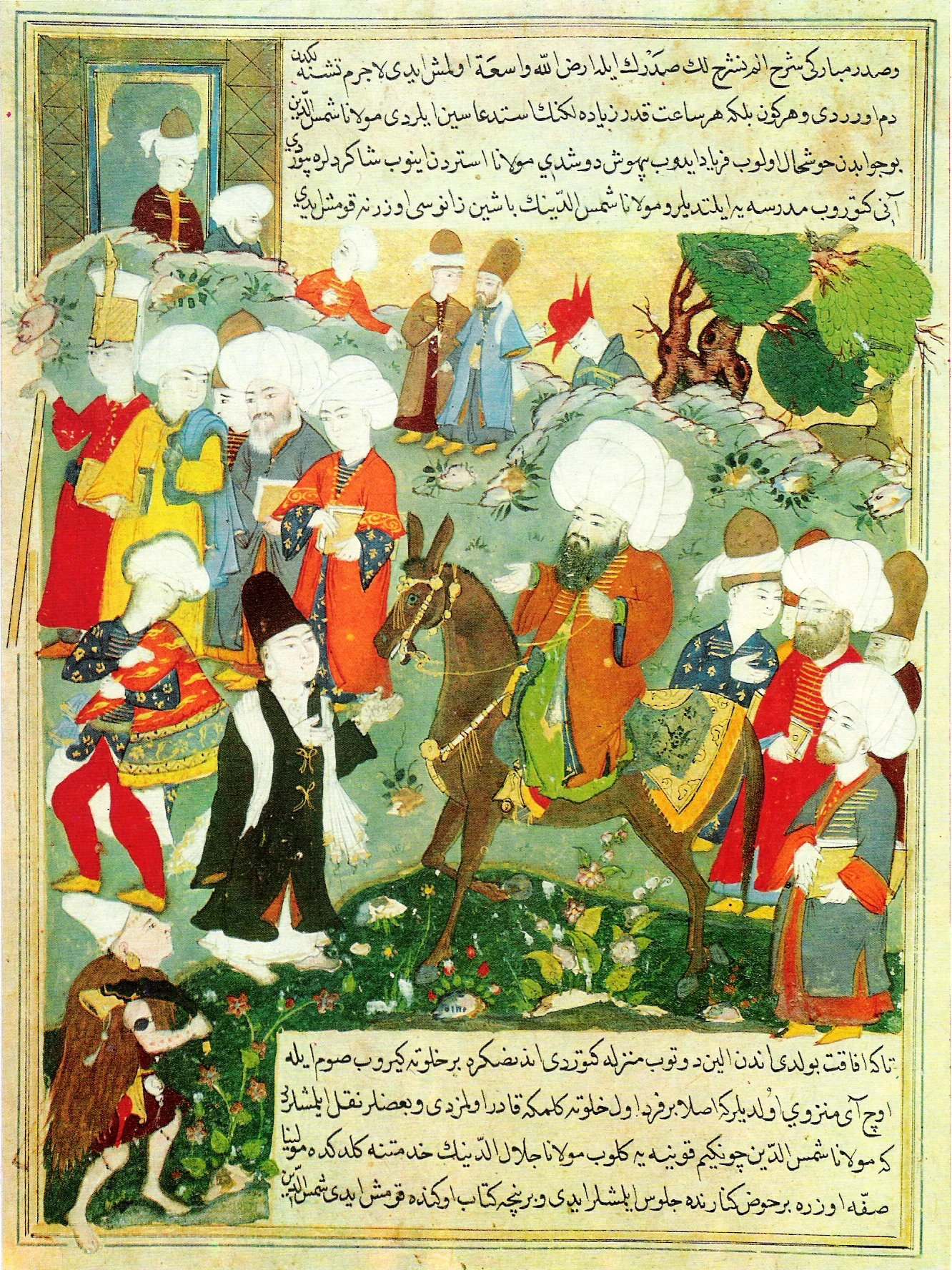
About 1185 to about 1248 (he disappeared) · Tabriz; Konya (Anatolia)
Life
Shams al-Din of Tabriz was a wandering dervish of about sixty when he met Jalal al-Din Rumi in Konya in 1244. For months the two shut themselves away in conversation. Rumi's students, jealous, drove Shams away; Rumi sent his son to bring him back from Damascus. Around 1247 or 1248 Shams disappeared for good. A later story says he was murdered; nothing is certain. Rumi turned to poetry, and named his great collection of lyrics after him, the Divan of Shams of Tabriz. Shams's own talks survive as the Maqalat.
What they saw
Shams scorned scholars who knew the books and not the thing. He wanted direct seeing. And love that burns away reputation. The Maqalat are blunt, funny and unkind to the learned.
What he did to Rumi is his real teaching. He broke a great scholar's sense of himself, and from that break came some of the greatest love poetry in any language.
Sufi tradition says the meeting was of two oceans. The site would add that the one who drowned was the scholar's I-claim.
In their words
In paraphrase: you have read every book, but what have you seen? Knowledge that does not take you out of yourself is only a heavier self.
After the Maqalat of Shams of Tabriz; paraphrase, not a quotation.
Where this path meets the others
Shams and Rumi belong together; see Rumi and Rumi and the Upanishads.
He stopped the mule and asked the question.
Works
- Maqalat (Discourses)13th century
Further reading
- Me and Rumi: The Autobiography of Shams-i Tabrizi, tr. William C. Chittick (2004; in copyright)
- Franklin D. Lewis, Rumi: Past and Present, East and West (2000; in copyright)
Next on your path
Sources
- Lewis (2000), for the meeting (1244), the disappearance and the legends, paraphrased.
- The Maqalat, paraphrased.