Ramakrishna
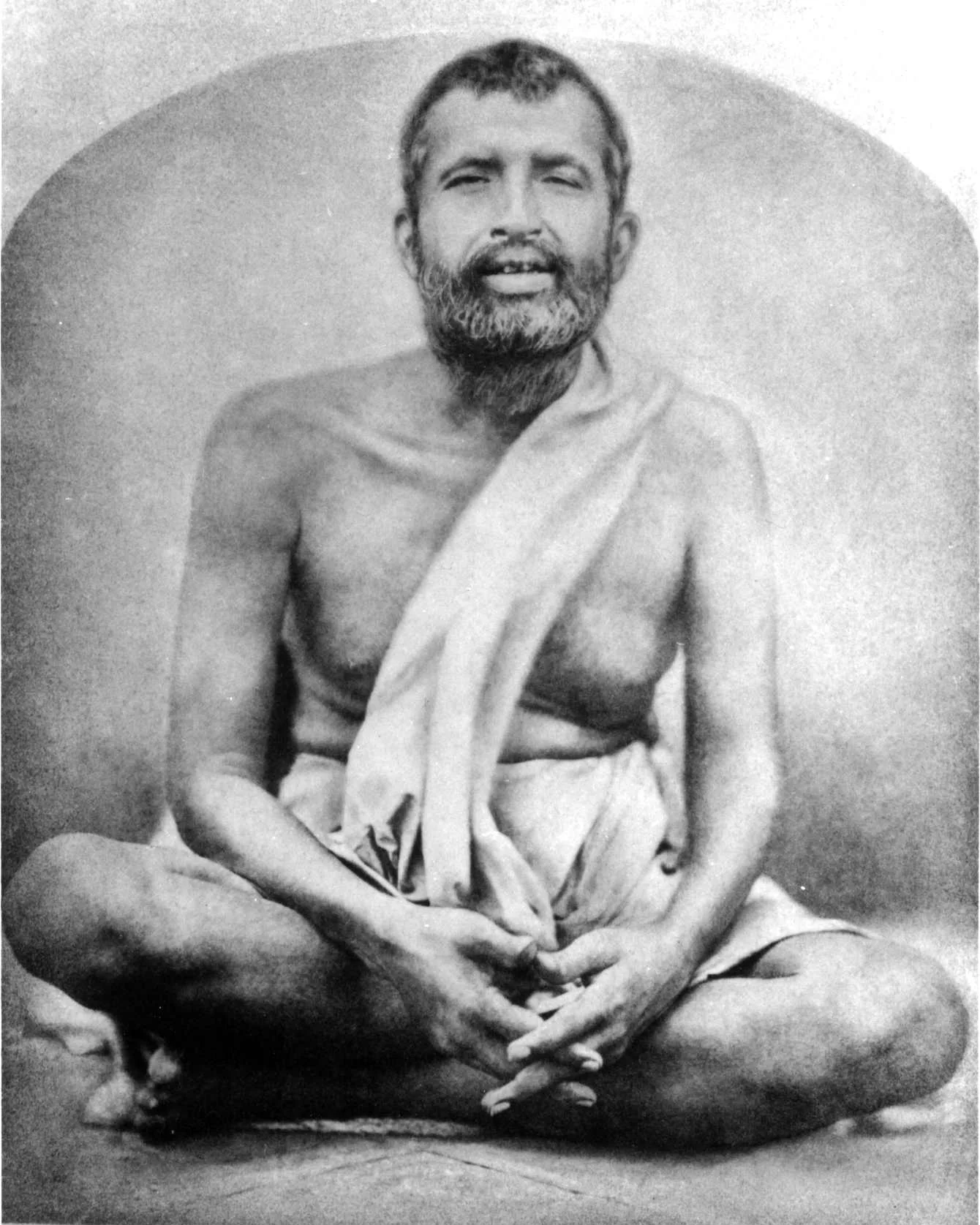
18 February 1836 to 16 August 1886 · Born at Kamarpukur, Bengal; priest at the Dakshineswar Kali temple near Calcutta; died at Cossipore
Life
Gadadhar Chattopadhyay was born in a poor Brahmin family in rural Bengal and had little schooling. From 1855 he served at the new Kali temple at Dakshineswar on the Ganga, and became its priest the next year. His longing for the goddess was so intense that many thought him mad. Over the next years he practised under teachers of several paths: Tantra with a woman teacher, the Bhairavi Brahmani; Vaishnava devotion; Advaita with the wandering monk Totapuri, who taught him to go beyond every form; and, for short periods, Islam and Christianity. His wife, Sarada Devi, became his disciple. Young men gathered round him, Narendranath (later Vivekananda) among them, and many of them later became monks. He died of throat cancer in 1886.
What they saw
Ramakrishna taught in stories, never systems. The whole is formless and also with form, he said, as water is ice and water. The one who sees it without form and the one who loves it in form are not opposed.
His most famous saying is that there are as many paths as there are views, and all reach the same goal, as many ghats lead down to the same lake. He had tested it himself.
His conversations were written down by a schoolteacher, Mahendranath Gupta, and published in Bengali as the Kathamrita.
In their words
Jata mat, tata path. Plain rendering: As many views, so many paths.
Saying of Ramakrishna, recorded in the Kathamrita of Mahendranath Gupta (Bengali, 1902 to 1932); rendering made for notdual.org (draft)
Where this path meets the others
Ramakrishna's many paths are the root of this site's own starting point; see Ramakrishna and many paths. Vivekananda carried them to the world.
Many ghats, one lake.
Works
- Sri Sri Ramakrishna Kathamrita, recorded by Mahendranath Gupta1902 to 1932
Further reading
- The Gospel of Sri Ramakrishna, tr. Swami Nikhilananda (1942; in copyright)
- Christopher Isherwood, Ramakrishna and His Disciples (1965; in copyright)
Next on your path
Sources
- Mahendranath Gupta, Sri Sri Ramakrishna Kathamrita (5 vols., 1902 to 1932), for the sayings; the Bengali phrase is widely cited.
- Isherwood (1965), for the life, paraphrased.