Parmenides
Born c. 515 BCE; active in the first half of the 5th century BCE · Elea, a Greek city in southern Italy
Life
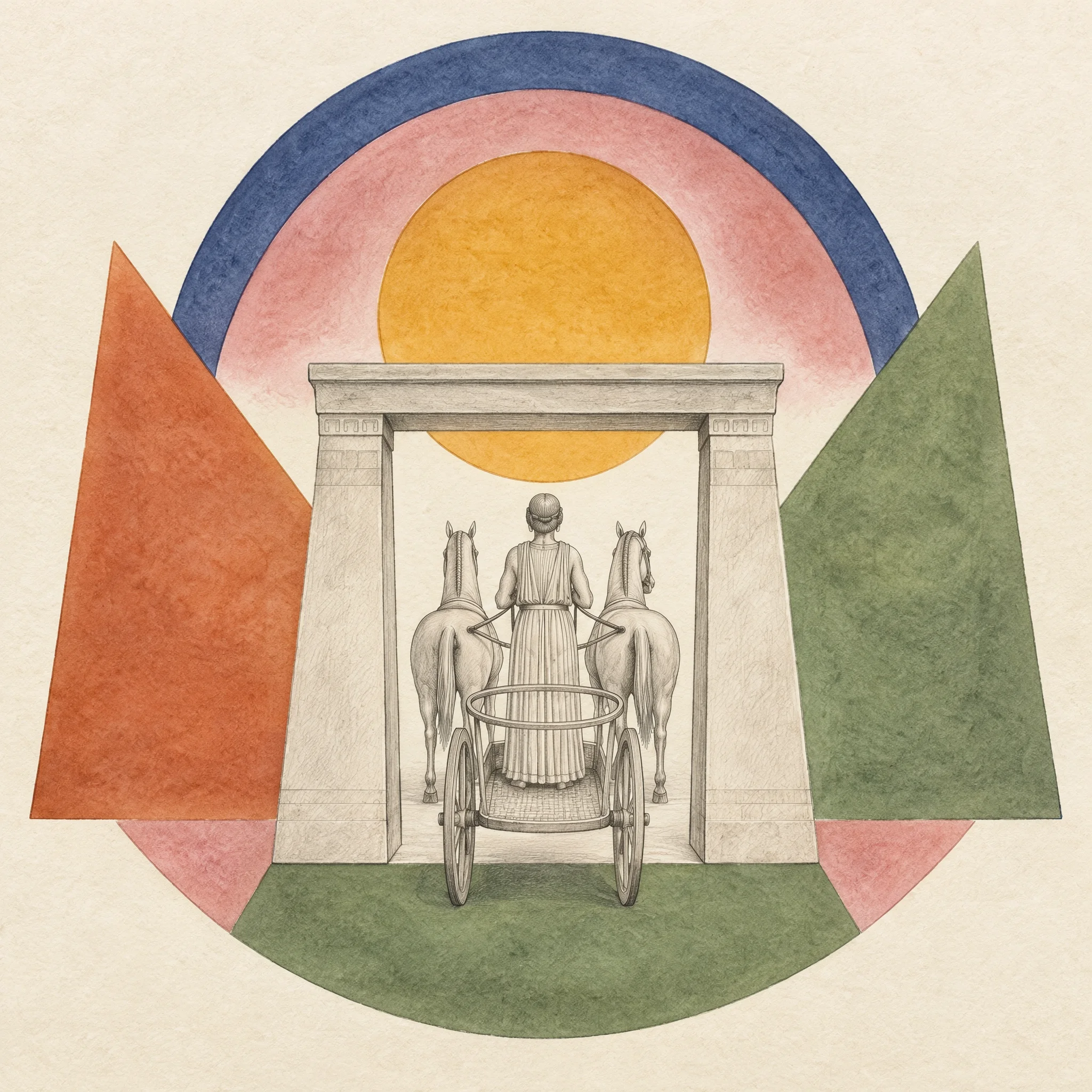
Parmenides lived in Elea, a Greek colony south of Naples, and is said to have given the city its laws. He wrote a single poem. About a hundred and sixty lines survive. In it a young man is carried by a chariot to a goddess, who teaches him two ways: the way of truth and the way of opinion. Plato's dialogue Parmenides imagines him, as an old man, visiting Athens and meeting the young Socrates.
What they saw
The goddess says: only what is, is; what is not cannot be thought or said. So being cannot have come from nothing, cannot pass into nothing, and cannot be divided, since there is nothing other than being to divide it. Being is one, whole and unmoving. Change and the many belong to the way of opinion: how things seem to mortals.
He also made a remarkable link: thinking and being are the same. Whatever can be thought must be; being is what thought is always already touching.
In their words
“for it is the same thing that can be thought and that can be.”
Parmenides, fragment 3 (Diels-Kranz numbering), tr. John Burnet
“One path only is left for us to speak of, namely, that It is.”
Parmenides, fragment 8 (Diels-Kranz numbering), tr. John Burnet
Where this path meets the others
His being, uncreated and undivided, is a near match for Advaita's sat, and his two ways close to Shankara's two standpoints. But Parmenides tends to set the many aside as mere opinion, where Advaita keeps the world as real appearance, dependent on being. See What is real?
Whatever you think of, being was there first.
Works
- On Nature (the poem)early 5th century BCE
Further reading
- John Burnet, Early Greek Philosophy (1892; 2nd ed. 1908)
Next on your path
Sources
- Parmenides, fragments 3 and 8 (Diels-Kranz numbering), in John Burnet's translation, Early Greek Philosophy (1892; 2nd ed. 1908); checked against the Lexundria copy of Burnet's translation, which uses Diels-Kranz numbers. Public domain.
- Plato, Parmenides 127a to c (the visit to Athens).