Nicholas of Cusa
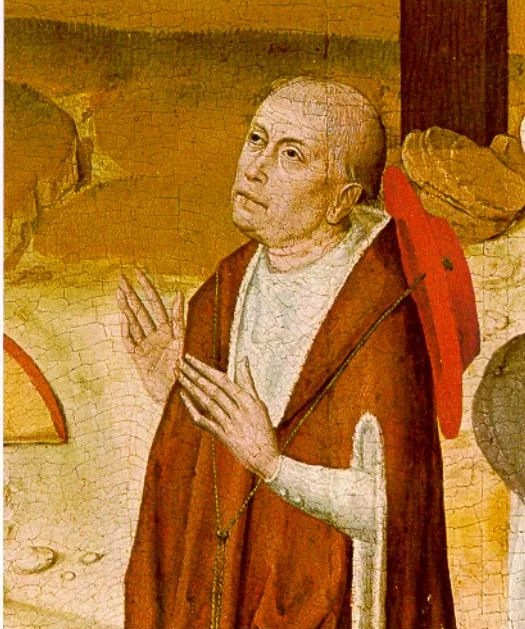
1401 to 11 August 1464 · Born at Kues (Bernkastel-Kues) on the Moselle, Germany; died at Todi, Italy
Life
Nicholas Krebs was born in 1401 at Kues on the Moselle, the son of a boatman. He studied law at Padua. He became a church diplomat, and in 1448 a cardinal. On a sea voyage back from Constantinople in 1437 he had the insight behind his book On Learned Ignorance (1440). He wrote on mathematics, the calendar and the peace of religions as well as theology. He died at Todi in 1464 and left his library to a hospice in Kues, where it still stands.
What they saw
Nicholas taught that the infinite cannot be measured by any finite mind, so the wise one knows that he does not know: learned ignorance. In the infinite, opposites coincide. The largest and the smallest, the circle and the straight line, meet there.
The painted face of The Vision of God (1453) turns this into practice. God's seeing, like the icon's gaze, is with every viewer at once and with each wholly. Its seeing is our being.
His coincidence of opposites is the Christian twin of “not two”. He kept God and creature distinct, as the church required; his reader may notice how close he comes to the line.
In their words
In paraphrase: in the infinite, the greatest and the least coincide; the wise know this by knowing that they cannot grasp it.
After Nicholas of Cusa, De docta ignorantia (1440), book 1; paraphrase, not a quotation.
Where this path meets the others
Nicholas's learned ignorance is the Cloud's cloud and the Kena's “not known by those who know it”. See Not this, not this and The Cloud of Unknowing.
The face looks at each of you.
Works
- On Learned Ignorance (De docta ignorantia)1440
- The Vision of God (De visione Dei)1453
- On the Peace of Faith (De pace fidei)1453
Further reading
- Nicholas of Cusa, The Vision of God, tr. Emma Gurney Salter (1928)
- Nicholas of Cusa, Of Learned Ignorance, tr. Germain Heron (1954; in copyright)
Next on your path
Sources
- Salter's translation of De visione Dei (1928), preface and chapter 1, for the icon, paraphrased.
- De docta ignorantia (1440), book 1, paraphrased; the sea-voyage insight is told in its closing letter.