Milarepa
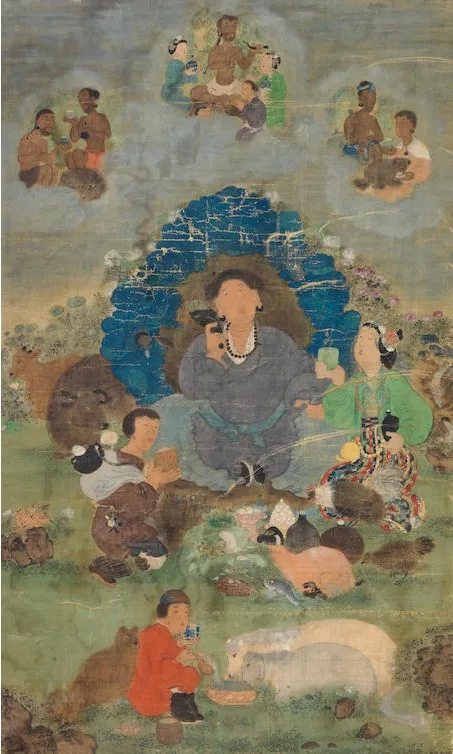
Traditionally 1040 to 1123 (some sources say 1052 to 1135) · Tibet: Gungthang, Lhodrak, and caves in the Himalaya
Life
Milarepa's life is known from a biography written in 1488 by Tsangnyön Heruka. His father died when he was a child. Relatives took the family's land. At his mother's urging he learned black magic and, the story says, killed many people in revenge. Filled with remorse, he went to the teacher Marpa the Translator, who made him labour for years before teaching him. He then lived in caves in the high Himalaya, so poor that he ate nettles until, the story says, his skin turned green. He taught in songs, which were collected as the Hundred Thousand Songs.
What they saw
Milarepa is loved because his life is the whole arc in one person: crime, guilt, hard work, solitude and freedom. The towers were Marpa's way of wearing out the I-claim.
His songs are plain and often funny. He sings to hunters, to demons, to his sister who scolds him for living like a beggar. Again and again he points to the mind itself as the teacher, and to its nature as clear and empty, the same in a cave or a palace.
He shows that no one is too far gone to begin, and that the work happens in an ordinary, difficult life.
In their words
In paraphrase: I have no need of books; the mountains and my own mind are my teachers. Seen clearly, the mind is the same in a cave or in a palace.
After the songs of Milarepa (Hundred Thousand Songs); paraphrase, not a quotation.
Where this path meets the others
Milarepa's labour under Marpa is Dattatreya's freedom earned the hard way. See Longchenpa and Free while living.
Carry the stones back. Then sing.
Works
- The Hundred Thousand Songscompiled 1488
Further reading
- W. Y. Evans-Wentz (ed.), Tibet's Great Yogi Milarepa (1928)
- The Hundred Thousand Songs of Milarepa, tr. Garma C. C. Chang (1962; in copyright)
Next on your path
Sources
- Tsangnyön Heruka, The Life of Milarepa (1488), in Evans-Wentz (1928), paraphrased.
- Dates follow the traditional reckoning; sources differ.