Martin Buber
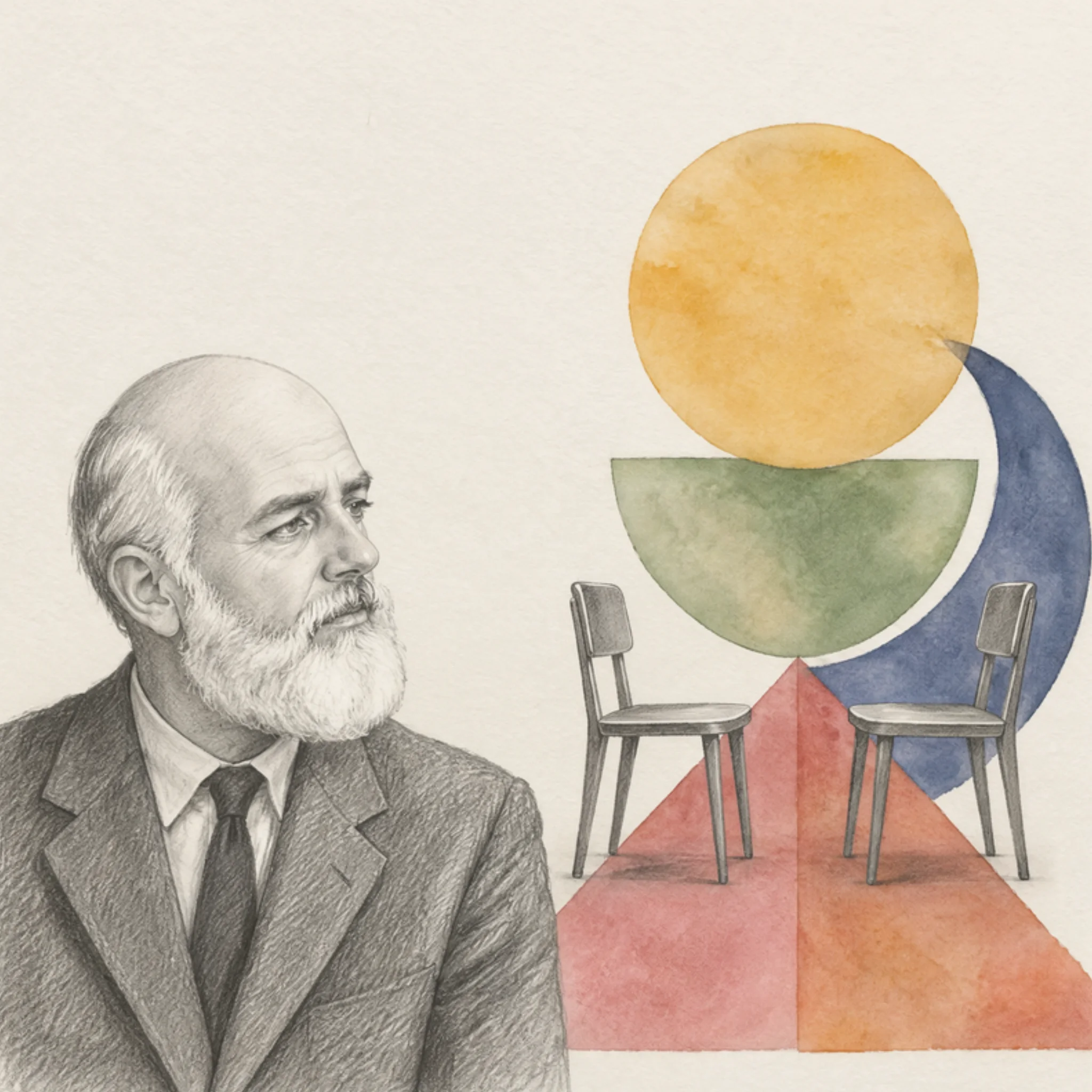
8 February 1878 to 13 June 1965 · Born in Vienna; grew up in Lviv (Lemberg); taught in Frankfurt; lived in Jerusalem from 1938
Life
Martin Buber was born in Vienna in 1878 and raised by his grandfather, a scholar, in Lemberg (Lviv). As a young man he collected and retold the tales of the Hasidim and wrote about mystical experience. His book I and Thou (Ich und Du, 1923) made him famous. He taught at Frankfurt until the Nazis forced him out, and in 1938 moved to Jerusalem, where he taught social philosophy and argued for peace between Jews and Arabs. He died there in 1965.
What they saw
Buber describes two attitudes. In I-It, I treat what I meet as an object to use or know. In I-Thou, I meet the other wholly, as present, without anything between us. Every real life, he says, is meeting.
He had once valued the mystical experience of unity, and he turned away from it after the episode with the young man. A unity in which the other disappears, he came to think, is a flight from the world. Meeting needs two to stay two.
This is a real parting from Advaita, and the site sets it out fairly. The site's reading is that what meets in I-Thou is one being on both sides; Buber would answer that the meeting matters more than what is shared.
In their words
In paraphrase: all real living is meeting. The Thou meets me; I step into direct relation with it.
After Martin Buber, I and Thou (1923; English tr. Ronald Gregor Smith, 1937; in copyright); paraphrase.
Where this path meets the others
Buber's I and Thou is the other side of Ramchandra Gandhi's I Am Thou, and his tales of the Hasidim connect him to the Baal Shem Tov. See Ramchandra Gandhi and Love.
Meet the one in front of you.
Works
- I and Thou (Ich und Du)1923
- Tales of the Hasidim1947 (English)
- Between Man and Man1947 (English)
Further reading
- Martin Buber, I and Thou, tr. Ronald Gregor Smith (1937; in copyright)
- Martin Buber, Tales of the Hasidim (1947; in copyright)
Next on your path
Sources
- Maurice Friedman, Martin Buber's Life and Work (1981 to 1983; in copyright), for the life, paraphrased.
- The episode with the young man: Buber's own account, “A Conversion”, in Between Man and Man (1947), paraphrased.