Mandana Mishra
c. 8th century CE · Probably Mithila (north Bihar), though some traditions place him at Mahishmati on the Narmada
Life
Mandana Mishra was a leading scholar of the Mimamsa school, which defends Vedic ritual, and later wrote the Brahmasiddhi, one of the earliest independent works of Advaita. The later hagiographies of Shankara (the best known dates from around the 14th century or after) tell of his debate with Shankara, judged by his wife Ubhaya Bharati, which Mandana lost; he then became Shankara's disciple Sureshvara. Many scholars, from M. Hiriyanna and S. Kuppuswami Sastri onward, think they were two people. Their views differ.
What they saw
Mandana's Advaita has its own shape. He says not-knowing belongs to individual persons, each with their own, rather than to one cosmic power. Vachaspati Mishra later follows him, and their line (called Bhamati, after Vachaspati's book) is one of the two great schools after Shankara.
He also held that hearing the great sentences is not enough by itself. Repeated meditation on their meaning (prasankhyana) is needed to make the knowledge stick. Sureshvara argued hard against this. If the teaching gives knowledge, it gives it directly; meditation can clear the mind but cannot produce what was already so.
The argument still matters to readers. Is freedom a recognition that happens on hearing, or a practice that ripens over years? Advaita has room for both answers, and Mandana is the source of one of them.
In their words
In paraphrase: the not-knowing that hides the whole belongs to each person, as each sleeper has his own dream.
After Mandana Mishra, Brahmasiddhi; paraphrase, not a quotation.
Where this path meets the others
Mandana's debate with Shankara is retold in Stories, and his line runs through Vachaspati Mishra. See Sureshvara and Vachaspati Mishra.
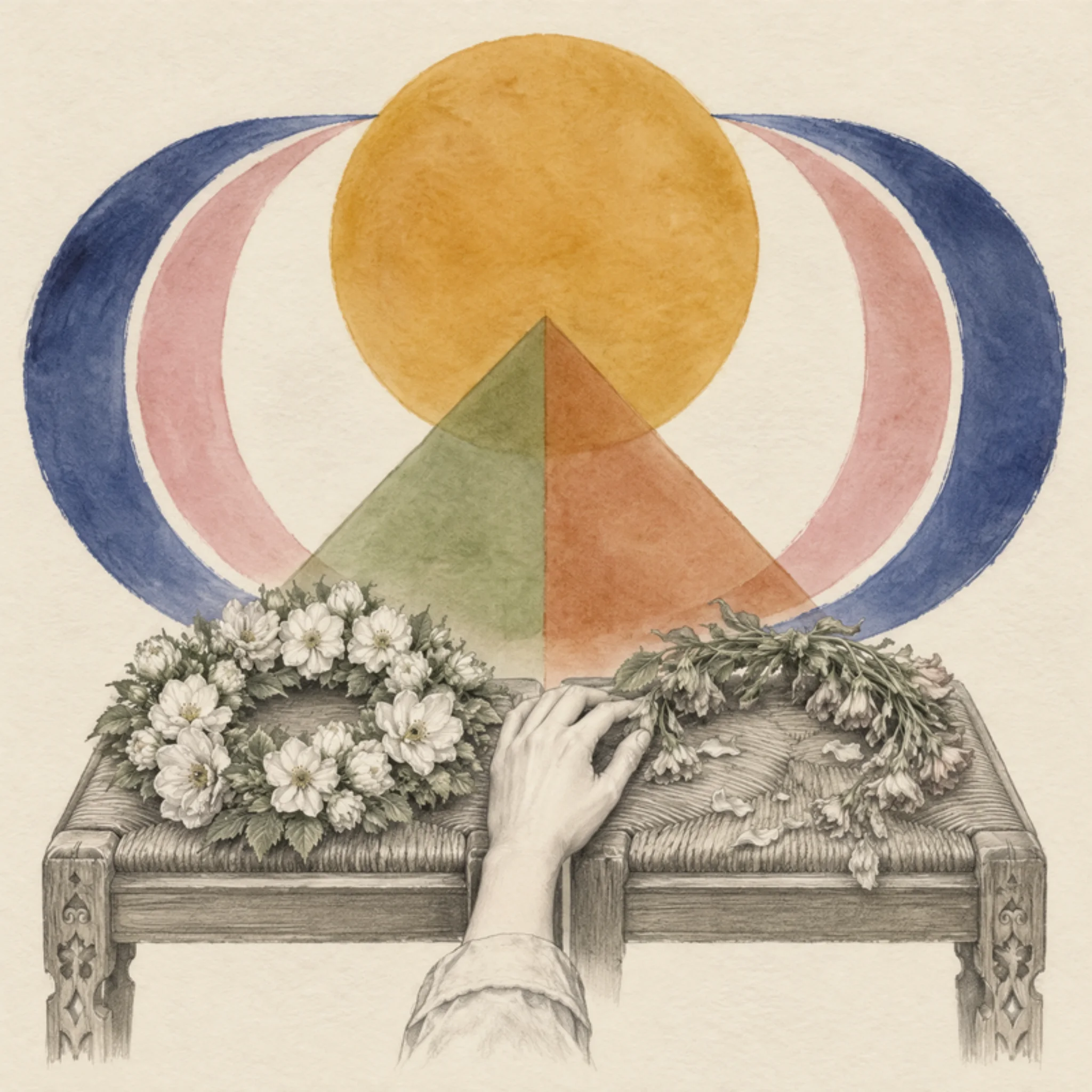
Whose garland faded first?
Works
- Brahmasiddhic. 8th century CE
Further reading
- Brahmasiddhi by Acharya Mandanamisra, ed. S. Kuppuswami Sastri (Madras, 1937)
- Allen Wright Thrasher, The Advaita Vedanta of Brahma-siddhi (1993; in copyright)
Next on your path
Sources
- Kuppuswami Sastri's introduction to the Brahmasiddhi (1937) and Thrasher (1993), for the views and the identity question, paraphrased.
- The debate and the garlands: Madhaviya Shankaradigvijaya (date debated, often placed in the 14th to 17th centuries), legend.
- M. Hiriyanna, “Sureśvara and Maṇḍana Miśra”, Journal of the Royal Asiatic Society (1923).