Laozi
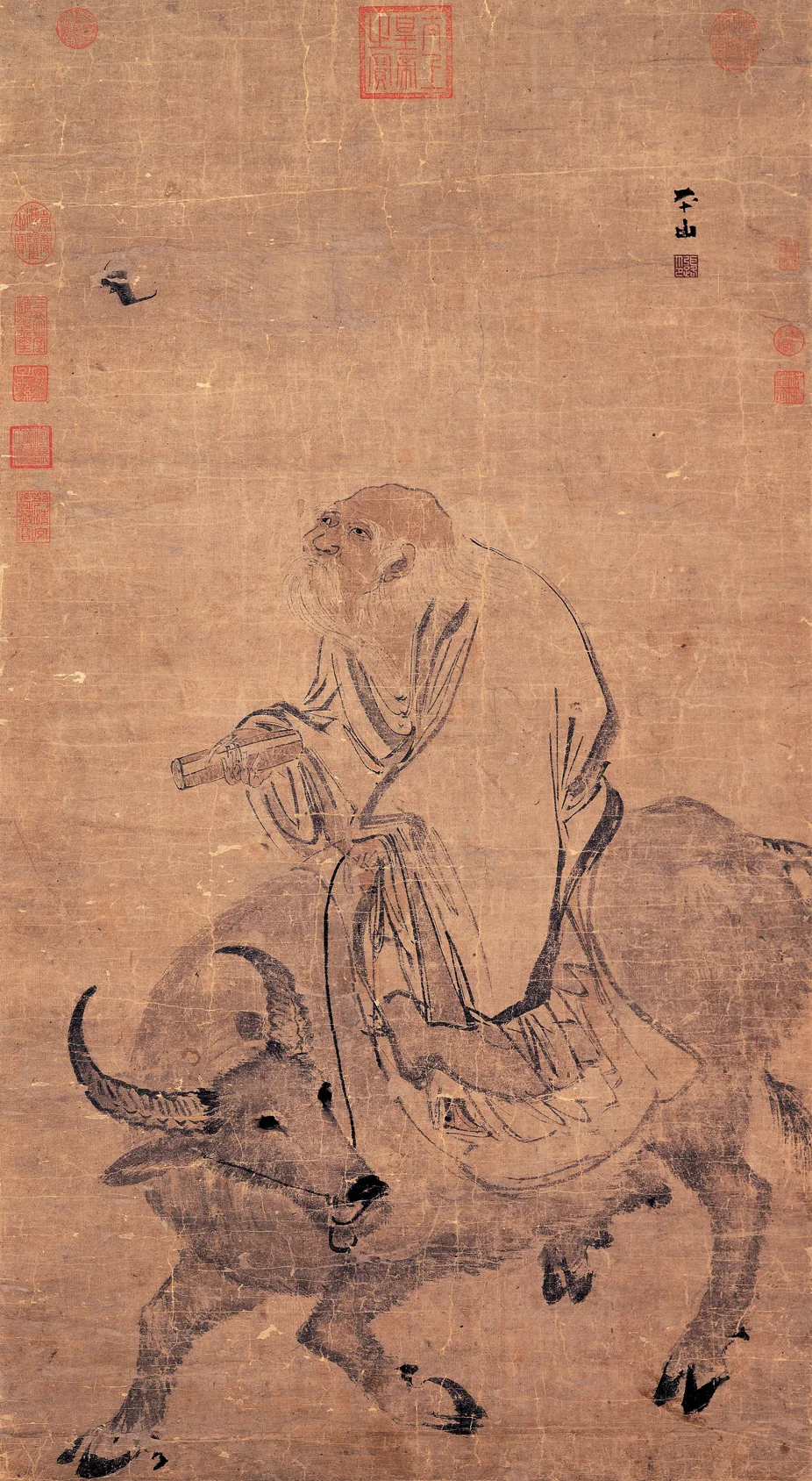
Traditionally 6th century BCE; the Tao Te Ching probably took shape around the 4th century BCE · China (the traditional account places him at the Zhou court)
Life
Almost nothing about Laozi can be checked. The historian Sima Qian, writing around 100 BCE, already gave more than one account: in the best known, Laozi was keeper of the archives at the Zhou court, and, weary of its decline, rode west; at the border pass a guard asked him to write down his teaching, and he left the Tao Te Ching, about five thousand characters, and was never seen again. Modern scholars mostly see the book as gathered over time, reaching its form around the fourth century BCE.
What they saw
The Tao is the source and course of everything. It cannot be named. Every name picks out a part. It gives life to all things and does not claim them. The sage follows it by not forcing (wu wei): doing what is needed, and no more, the way water finds its level.
Laozi values what others overlook: the empty centre of the wheel, the hollow of the bowl, the low valley, the soft water that wears away stone. Trouble, he says, begins when I hold the body as “myself” and grasp at gain and fame. Let that go. The Way does the rest.
In their words
“The Tao that can be trodden is not the enduring and unchanging Tao. The name that can be named is not the enduring and unchanging name.”
Tao Te Ching, chapter 1, tr. James Legge (1891)
“He who knows other men is discerning; he who knows himself is intelligent.”
Tao Te Ching, chapter 33, tr. James Legge (1891)
Where this path meets the others
The nameless Tao stands close to the whole that Advaita describes by “not this, not this”, and wu wei is close to the Gita's action without the claim “I am the doer”. Laozi does not speak of a Self, and the Meetings note that difference. See No outward mark.
The wheel turns on its empty centre.
Works
- Tao Te Chingprobably took shape around the 4th century BCE
Further reading
- The Tao Teh King, tr. James Legge (1891)
- Tao Te Ching, tr. D. C. Lau (1963; in copyright)
Next on your path
Sources
- The Tao Teh King, tr. James Legge, Sacred Books of the East vol. 39 (Oxford, 1891), chapters 1, 11, 13, 33. Public domain.
- Sima Qian, Records of the Grand Historian (Shiji), chapter 63, biography of Laozi (about 100 BCE); paraphrased.
- Dating of the Tao Te Ching: the Guodian bamboo slips (about 300 BCE) contain parts of it; scholarly views vary.