Lalla (Lal Ded)
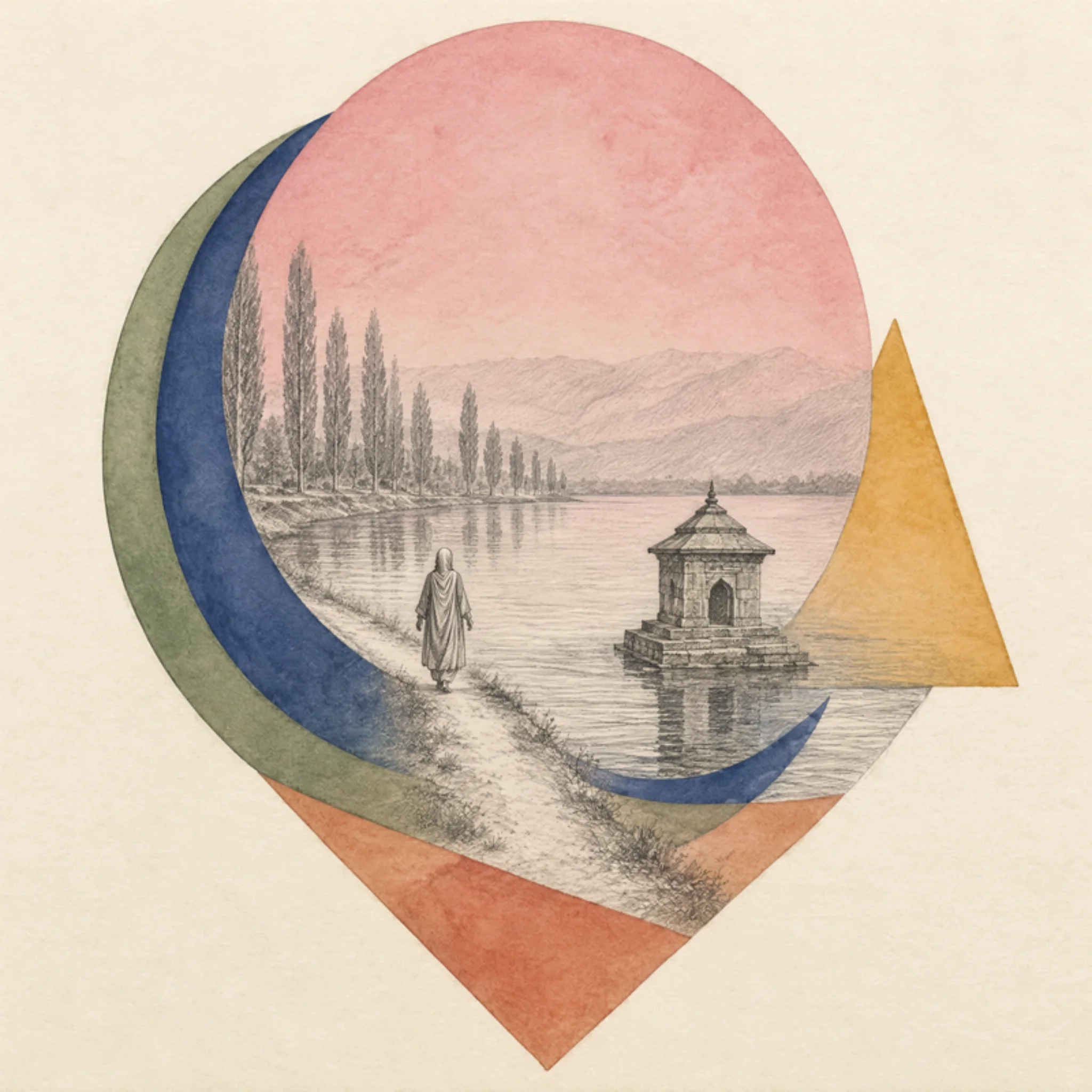
14th century (traditionally about 1320 to 1392; dates uncertain) · Kashmir, near Srinagar
Life
Lalla, also called Lal Ded (Granny Lal) and Lalleshwari, lived in 14th-century Kashmir. Married young into an unkind household, she left and became a wandering ascetic, by tradition a disciple of a Shaiva teacher named Siddha Srikantha. She wandered, it is said, unclothed. Her short poems (vakhs) were passed on orally and are among the oldest writing in Kashmiri. Both Kashmiri Hindus and Muslims claim her; the Sufi Nund Rishi is said to have honoured her.
What they saw
Her vakhs are four plain, sharp lines. She speaks of searching everywhere for Shiva and finding him at home, in her own self. She mocks the pilgrim who carries stones to worship and the scholar who knows the texts and not the thing.
Her background is the Shaivism of Kashmir: the world as the play of Shiva's own light, and freedom as recognising it. She adds hard practice, breath and silence, and an absolute refusal of pretence.
The stone in the rice is a good emblem. The bowl looked full. She knew what was in it, and was not troubled either way.
In their words
In paraphrase: I, Lalla, went out looking for him far and wide. Then, coming home, I found the Lord in my own house.
After a vakh of Lalla; paraphrase. Older versions: Grierson and Barnett, Lalla-Vakyani (1920); Temple, The Word of Lalla (1924, public domain).
Where this path meets the others
Lalla lived inside Kashmir Shaivism's recognition, and her poems meet Kabir's in their scorn for outward show. See Kashmir Shaivism and Advaita and Rabia and the love that leaves no lover.
She washed the stone and put it back.
Works
- Vakhs (sayings)14th century; collected later
Further reading
- George Grierson and Lionel D. Barnett, Lalla-Vakyani (Royal Asiatic Society, 1920)
- Sir Richard Carnac Temple, The Word of Lalla the Prophetess (1924)
- Ranjit Hoskote, I, Lalla (2011; in copyright)
Next on your path
Sources
- Grierson and Barnett (1920) and Temple (1924), for the vakhs and the traditional life, paraphrased.
- The rice-and-stone story and her teacher's name are tradition, not history.