Jacob Boehme
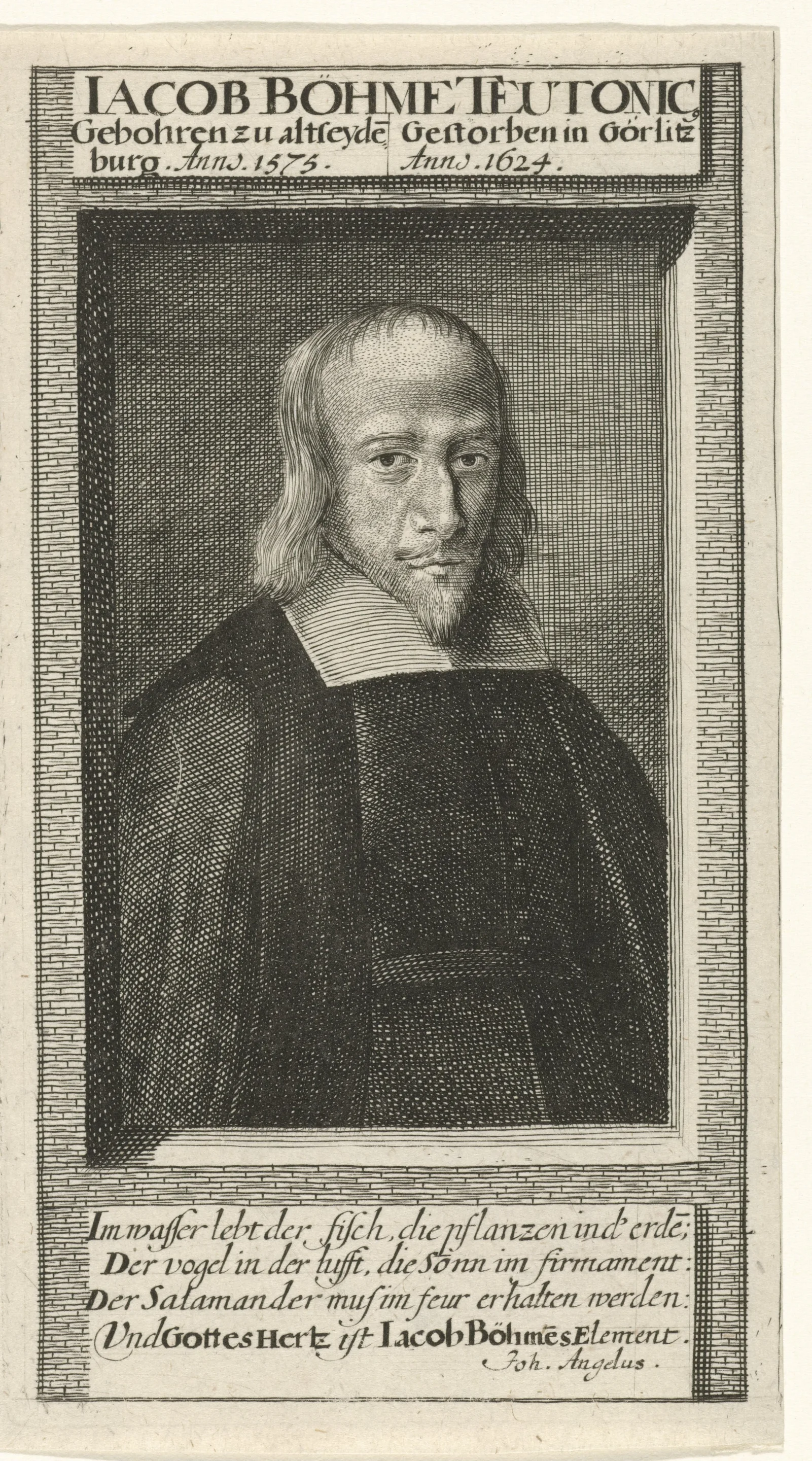
1575 to 17 November 1624 · Born at Alt Seidenberg; a shoemaker in Görlitz, Upper Lusatia
Life
Jacob Boehme was born to a farming family and apprenticed as a shoemaker, settling in Görlitz. After the vision of 1600 he kept silent for twelve years. Then he wrote Aurora (Morgenröte, 1612). The local Lutheran pastor denounced him and the town council forbade him to write. He obeyed for some years, then wrote many more works. He died in 1624. His books were translated into English in the 17th century and influenced the Quakers, Newton's circle, William Blake, Hegel and Schelling.
What they saw
Boehme's God begins as the Ungrund, the groundless: a will without any object, before there is anything, even God as known. From the groundless comes a longing to see itself, and from that longing, through stages of darkness and light, comes everything that is.
He saw conflict in God and in nature, wrath and love, and taught that they are reconciled in a unity beneath them both.
The groundless is close to the whole before any name, and the longing to be known to the order that brings appearance out. His dynamic God, with darkness in it, is his own.
In their words
In paraphrase: before nature and creature, there is the groundless, an eternal nothing that longs to see and know itself, and from that longing everything comes.
After Jacob Boehme, Mysterium Magnum (1623); paraphrase. The English translation of John Sparrow (1654) is public domain.
Where this path meets the others
Boehme's groundless descends from Eckhart's ground and passed to Schelling and Hegel. See Meister Eckhart and Schelling.
Sunlight on a pewter dish.
Works
- Aurora (Morgenröte im Aufgang)1612
- Mysterium Magnum1623
- The Way to Christ1624
Further reading
- The Works of Jacob Behmen, ed. William Law, 4 vols. (1764 to 1781)
- Andrew Weeks, Boehme (1991; in copyright)
Next on your path
Sources
- Weeks (1991), for the life and the pewter dish (from Abraham von Franckenberg's early life of Boehme), paraphrased.