Huineng
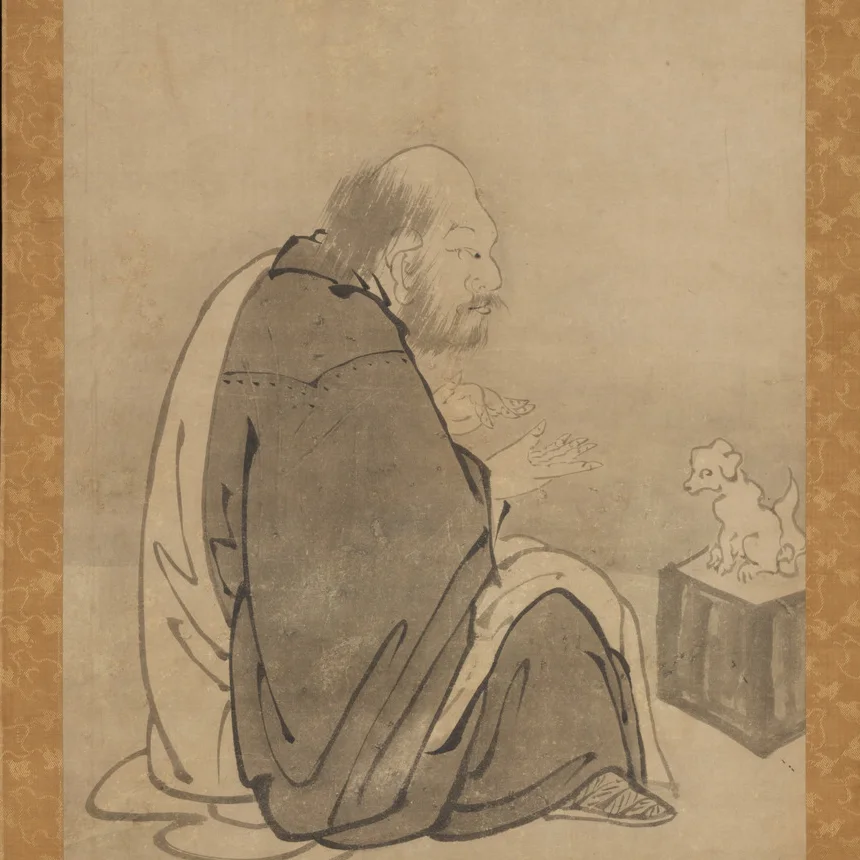
638 to 713 CE · Southern China (Guangdong); taught at Caoxi
Life
According to the Platform Sutra, Huineng was a poor, unlettered woodcutter from the south. Hearing a customer recite the Diamond Sutra, he understood it at once, and went north to the monastery of the fifth ancestor, Hongren, where he was put to work pounding rice. When Hongren asked his monks to write a verse showing their understanding, the senior monk wrote that the mind is a mirror to be kept free of dust. Huineng could not write. He had a verse written on the wall in reply: there is no mirror and no dust. Hongren secretly passed him the robe and bowl of the lineage, and Huineng went south, later teaching at Caoxi.
What they saw
Huineng taught that our own nature is originally pure and complete. It does not need polishing. It needs to be seen. Seeing it is sudden, not the end of a long ladder, though practice goes on after.
For him meditation and wisdom are not two: meditation is the body of wisdom, and wisdom is the working of meditation. And the seeing happens in ordinary life, not apart from it.
In their words
本來無一物,何處惹塵埃。Plain rendering: From the start not one thing exists. Where could dust settle?
Huineng's verse, Platform Sutra (later recension); rendering made for notdual.org (draft)
Where this path meets the others
His mirror-and-dust verse is close to Advaita's claim that knowledge removes a covering and adds nothing, and to Gaudapada's “nothing was born”. See Zen and Advaita.
Nothing to polish. Only something to see.
Works
- Platform Sutra of the Sixth Patriarch8th century CE (Dunhuang text); later recensions to 1291
Further reading
- The Platform Sutra, many translations (e.g. Philip Yampolsky, 1967, from the Dunhuang text; in copyright)
Next on your path
Sources
- Platform Sutra of the Sixth Patriarch (Liuzu Tanjing): the life story and the verse contest, retold in plain words. The life story is the tradition's own account and cannot be checked historically.
- The quoted line follows the later recension (Zongbao, 1291); the Dunhuang manuscript has a different third line.
- Dates 638 to 713 as traditionally given.