Hakuin Ekaku
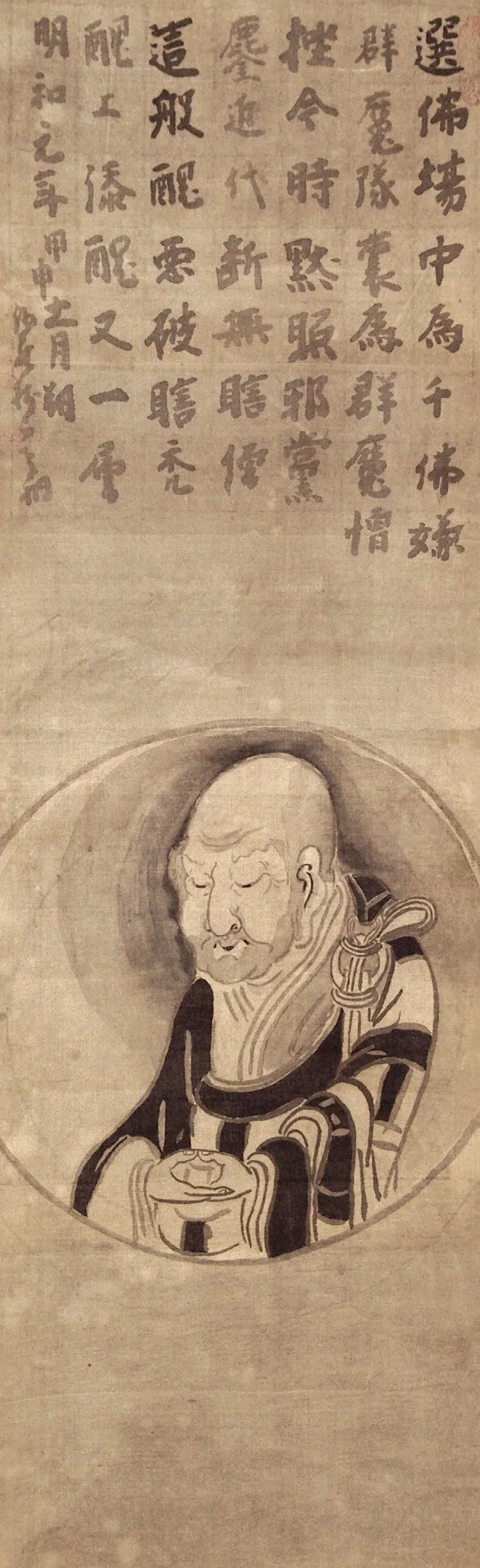
19 January 1686 to 18 January 1769 · Hara, Suruga province (Shizuoka), Japan
Life
Hakuin was born in 1686 at Hara, a post town on the road between Kyoto and Edo, and became a monk at fifteen. After years of hard practice, a breakdown he called Zen sickness, and recovery, he returned to his small temple at Hara, the Shoin-ji, and stayed there most of his life. He revived the Rinzai school, which had grown slack, organised koan training into a system still used, and wrote in plain Japanese for ordinary people. He also left hundreds of ink paintings and calligraphies. He died in 1769.
What they saw
Hakuin's most famous koan asks you to hear the sound of one hand. Two hands clap and make a sound. What is the sound of one? The question is built so that thought cannot settle it, and so that the one hearing is thrown back on itself.
His Song of Zazen opens by saying that all beings are buddhas from the start, like ice and water: no ice without water, no buddhas apart from beings. We look far away for what is close, like someone in water crying of thirst.
The village story, told in later collections and probably legend, shows the same thing in conduct: the steady one under pressure, with no reputation to defend.
In their words
衆生本来仏なり。Plain rendering: All beings are buddhas from the very start.
Hakuin, Song of Zazen (Zazen wasan), opening line; Japanese original with a rendering made for notdual.org (draft)
Where this path meets the others
Hakuin's ice and water is Advaita's wave and sea. His “Is that so?” is the Gita's steady one. See No outward mark.
Is that so?
Works
- Song of Zazen (Zazen wasan)18th century
- Orategama1749 (continuation 1751)
- Yasenkanna1757
Further reading
- The Essential Teachings of Zen Master Hakuin, tr. Norman Waddell (1994; in copyright)
- Wild Ivy: The Spiritual Autobiography of Zen Master Hakuin, tr. Norman Waddell (1999; in copyright)
Next on your path
Sources
- Waddell's translations (1994, 1999), for the life, paraphrased.
- Song of Zazen: Japanese text, first line; the ice-and-water image paraphrased from the following lines.
- The village story (“Is that so?”) is a popular tale of uncertain origin.