Fazang
643 to 712 CE · Chang'an (Xi'an), China
Life
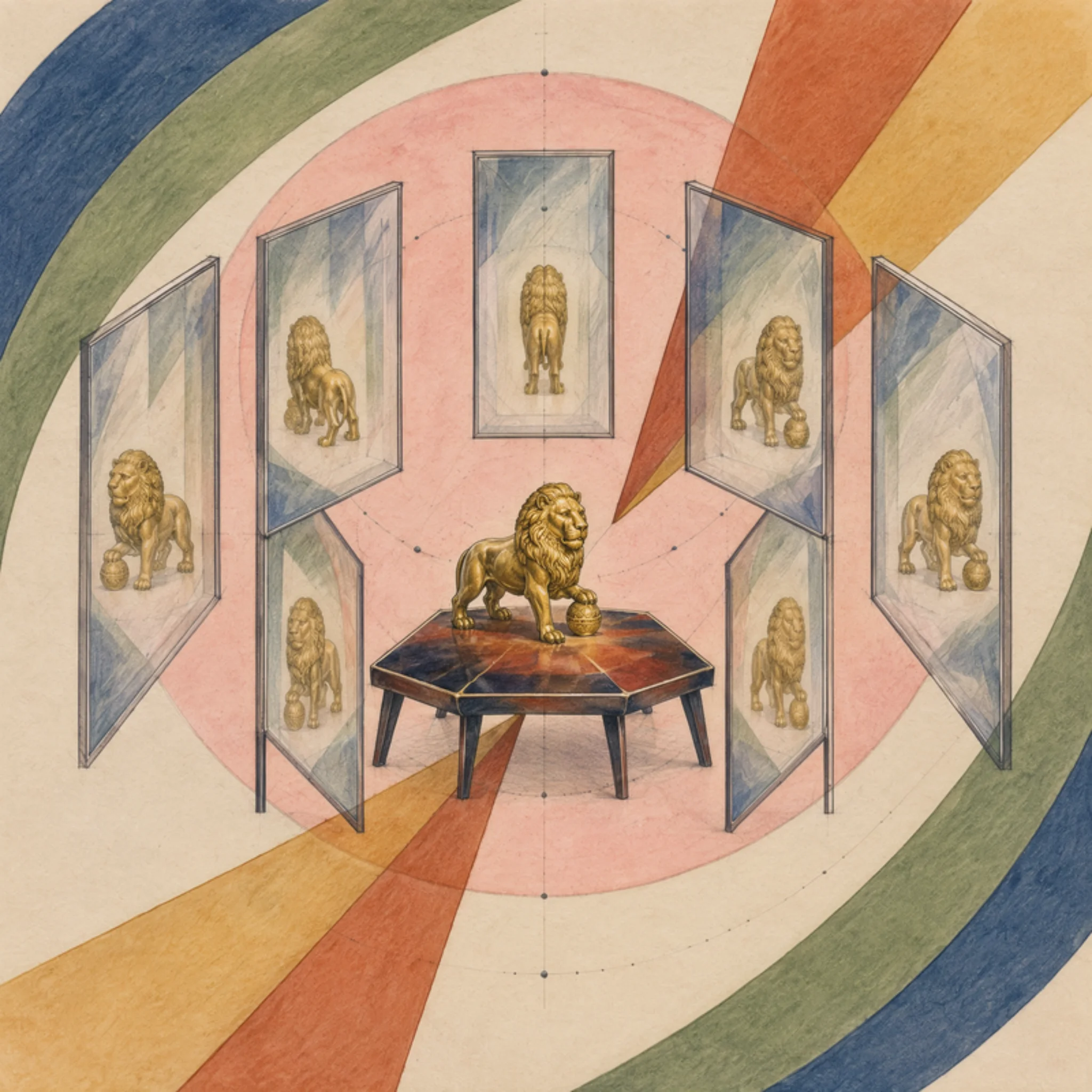
Fazang was born in Chang'an in 643, to a family of Sogdian descent. He became the leading thinker of the Huayan school of Chinese Buddhism, named after the Avatamsaka (Flower Garland) Sutra. He taught at the court of Empress Wu Zetian, and tradition says he explained Huayan to her with two images: a golden lion in the palace, and the hall of mirrors. His short Treatise on the Golden Lion survives. He died in 712.
What they saw
The golden lion is the way in. The gold has no shape of its own; the lion has no substance of its own. Every part of the lion, eye, ear, hair, is all gold, and each part contains the whole lion's gold.
Huayan goes further. Every thing is in every other thing; each depends on all, and all on each, with no obstruction. This is the old image of Indra's net, a net of jewels in which each jewel reflects all the others.
Fazang's interpenetration is a Buddhist teaching about dependence, without a Self at the centre. Advaita would add: the gold is being. The meeting Indra's net and the whole looks at both.
In their words
In paraphrase: the gold has no nature of its own; the lion appears from it. In every hair of the lion is the whole gold, and so the whole lion.
After Fazang, Treatise on the Golden Lion (Jin shizi zhang); paraphrase, not a quotation.
Where this path meets the others
Fazang's lion is close to Advaita's clay and pot, and his net of jewels to the whole. See Indra's net and the whole.
In every hair, the whole gold.
Works
- Treatise on the Golden Lionc. 700 CE
Further reading
- Fazang, Treatise on the Golden Lion, in Wing-tsit Chan, A Source Book in Chinese Philosophy (1963; in copyright)
Next on your path
Sources
- Wing-tsit Chan, A Source Book in Chinese Philosophy (1963), for the treatise and the hall of mirrors, paraphrased.
- The court episodes are from traditional biographies.