Ralph Waldo Emerson
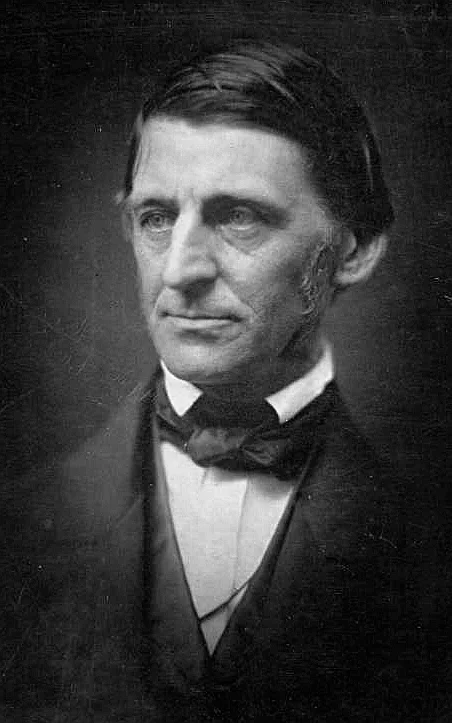
25 May 1803 to 27 April 1882 · Born in Boston; lived in Concord, Massachusetts
Life
Emerson trained as a Unitarian minister and left the pulpit in 1832, unable in conscience to administer communion. He became a lecturer and essayist, the centre of the Transcendentalist circle in Concord, and a friend and early supporter of Thoreau. He read widely in Indian texts in English translation: the Bhagavad Gita (in Charles Wilkins's 1785 version), the Laws of Manu, the Vishnu Purana and, later, translations from the Upanishads. His 1857 poem “Brahma” puzzled many readers.
What they saw
In “The Over-Soul” (1841) Emerson wrote that within every person is the soul of the whole: a universal mind in which each of us shares. We live in parts and particles. Yet the seer and the seen are one. Trust that, he said, and you need no borrowed authority; that is the root of his “Self-Reliance”, which means reliance on the whole speaking through you, not on the small self.
His poem “Brahma” turns Katha Upanishad 1.2.19 into English verse: the slayer and the slain do not understand, because the one behind them neither kills nor dies.
In their words
“We see the world piece by piece, as the sun, the moon, the animal, the tree; but the whole, of which these are the shining parts, is the soul.”
Emerson, “The Over-Soul”, Essays: First Series (1841)
“If the red slayer think he slays, / Or if the slain think he is slain,”
Emerson, “Brahma” (1857)
Where this path meets the others
His Over-Soul is close to the whole, and his “transparent eyeball” to the witness. He read the Upanishads through translators and through his own Romantic lens, and his “soul” is not exactly the Self. Compare Katha Upanishad 1.2.19 with “Brahma”. Then see Nachiketa and Death.
We see in parts. The seeing is whole.
Works
- Nature1836
- The Over-Soul (Essays: First Series)1841
- Self-Reliance (Essays: First Series)1841
- Brahma (poem)1857
Further reading
- Emerson, Nature (1836); Essays: First Series (1841); Poems (1847) and May-Day (1867)
- Arthur Christy, The Orient in American Transcendentalism (1932)
Next on your path
Sources
- Emerson, “The Over-Soul”, Essays: First Series (Boston: James Munroe, 1841); checked against the Standard Ebooks text. Public domain.
- Emerson, “Brahma”, first published in The Atlantic Monthly, November 1857. Public domain. Checked against the VCU Transcendentalism archive (first two lines).
- “Transparent eyeball”: Nature (1836), chapter 1; paraphrased.
- Katha Upanishad 1.2.19 (“If the killer thinks that he kills...”), tr. Max Müller (1884), is the source of “Brahma”.