Iris Murdoch
15 July 1919 to 8 February 1999 · Born in Dublin; taught at Oxford; died in Oxford
Life
Jean Iris Murdoch was born in Dublin and grew up in London. She studied classics at Oxford, worked in the Treasury and for refugee relief after the war, studied philosophy at Cambridge, and taught at St Anne's College, Oxford, from 1948 to 1963. She wrote twenty-six novels, among them The Sea, the Sea (Booker Prize, 1978), and books of philosophy, the best known The Sovereignty of Good (1970). She was married to the critic John Bayley. She died of Alzheimer's disease in 1999.
What they saw
Murdoch's moral philosophy is about attention. She took the word from Simone Weil. Morality, she said, is less about choices at big moments than about how we look at things and people all the time. The “fat relentless ego”, in her phrase, keeps making the world into its own story; goodness begins when that ego is quieted and we see what is actually there.
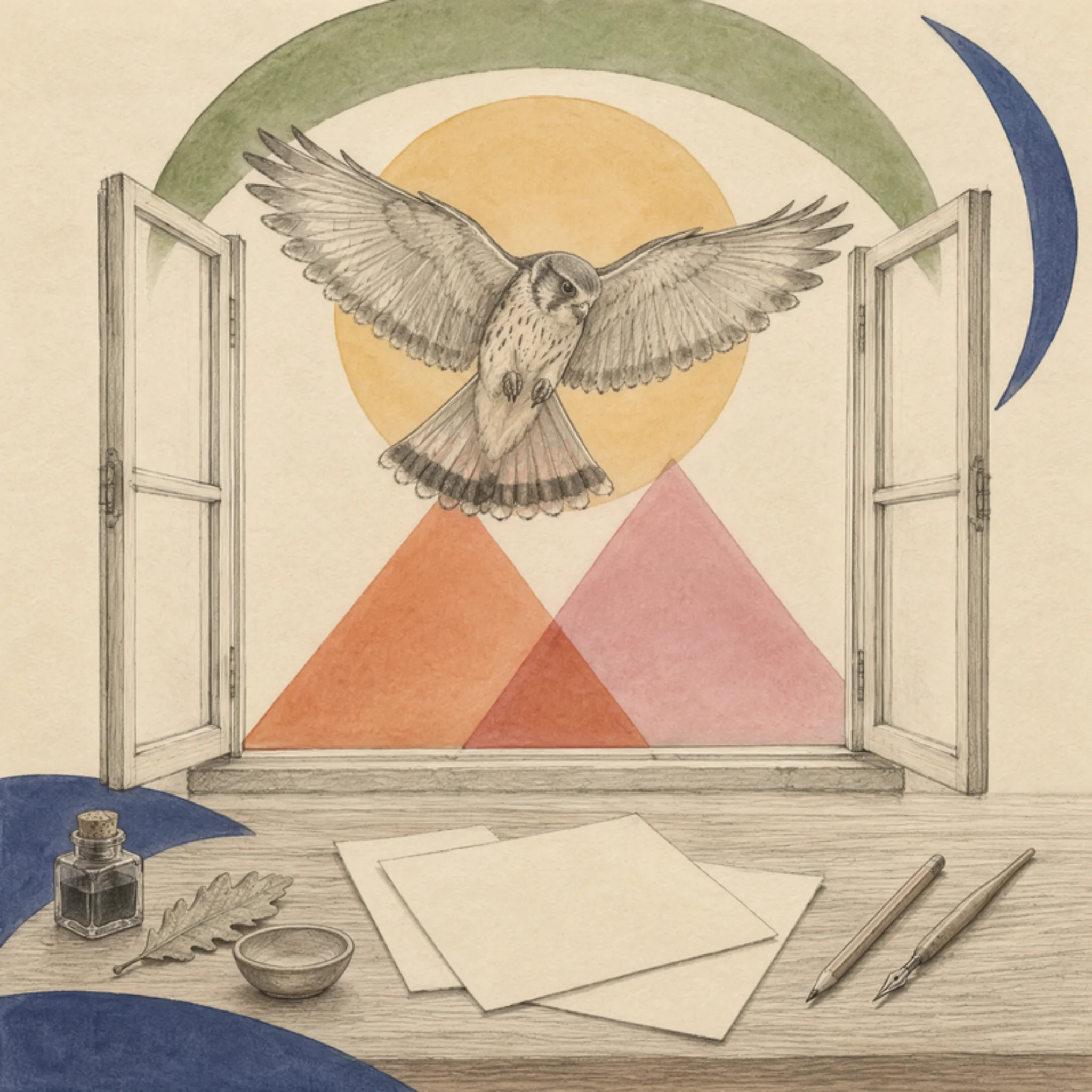
Her word for this is unselfing. The kestrel is her example: a moment in which, by attending to something beautiful and wholly other, the self's anxiety drops.
She was a Platonist, writing in plain English. Her unselfing is the I-claim falling, in a moment, through attention to what is not oneself.
In their words
In paraphrase: a sudden sight of a kestrel in the air can clear away a sulking self in an instant; for that moment there is only the bird.
After Iris Murdoch, The Sovereignty of Good (1970; in copyright); paraphrase.
Where this path meets the others
Murdoch carries Weil's attention into ethics, and her unselfing meets the I-claim. See Simone Weil and Attention.
Look out of the window. There is the kestrel.
Works
- The Sovereignty of Good1970
- Metaphysics as a Guide to Morals1992
Further reading
- Iris Murdoch, The Sovereignty of Good (1970; in copyright)
- Peter J. Conradi, Iris Murdoch: A Life (2001; in copyright)
Next on your path
Sources
- Conradi (2001), for the life, paraphrased.
- The kestrel: The Sovereignty of Good, essay 3, “The Sovereignty of Good over Other Concepts”, paraphrased (in copyright).