Angelus Silesius
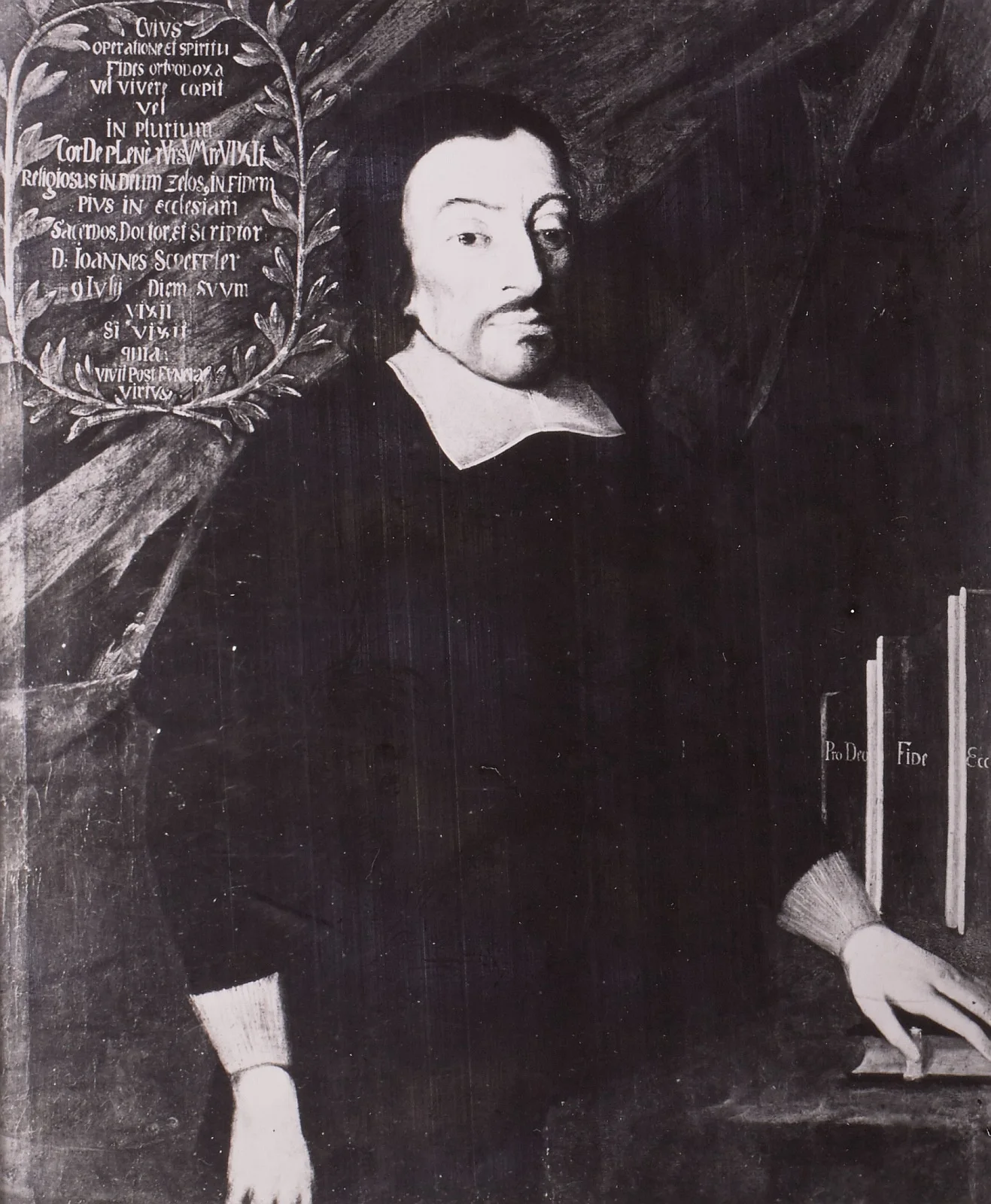
Baptised 25 December 1624; died 9 July 1677 · Breslau (Wrocław), Silesia
Life
Johann Scheffler was born in Breslau in 1624 to a Lutheran family, studied medicine in Strasbourg, Leiden and Padua, and became court physician to a duke in Silesia. Reading the German mystics, especially Jacob Boehme's circle and the medieval sermons in the Eckhart line, he turned toward Catholicism, converting in 1653 and taking the name Angelus Silesius, the Silesian angel. He was ordained a priest in 1661. His Cherubinic Wanderer (1657, enlarged 1675) is a book of over 1,600 rhymed couplets. In later life he wrote harsh controversial pamphlets. He died in Breslau in 1677.
What they saw
The couplets are short enough to remember and strange enough to stay. God is a pure nothing, one of them says, not touched by now or here. I am as great as God, says another, and he as small as I. You need not cry out to God. The spring is in you.
The rose couplet says everything in nine words. The rose does not bloom for a reason, or to be seen. It blooms. Living without why, from the ground and not for a result, is the oldest teaching of the German mystics, and Eckhart said it before him.
He stayed inside Catholic faith. His couplets go as near to not two as a Christian poem can.
In their words
Die Ros' ist ohn warum; sie blühet, weil sie blühet. Plain rendering: The rose is without why. It blooms because it blooms.
Angelus Silesius, Cherubinischer Wandersmann (1657 and 1675), book 1, couplet 289; German original with a rendering made for notdual.org (draft)
Where this path meets the others
“Without why” comes from Eckhart, and stands beside the Gita's action without attachment and Taoist wu wei. See Meister Eckhart and Action without attachment.
It blooms because it blooms.
Works
- The Cherubinic Wanderer (Cherubinischer Wandersmann)1657; enlarged 1675
Further reading
- Angelus Silesius, The Cherubinic Wanderer, tr. Maria Shrady (1986; in copyright)
- Selections tr. Paul Carus (1909)
Next on your path
Sources
- Cherubinischer Wandersmann, 1675 edition, book 1, couplet 289 (numbering as in the standard editions; check).
- General reference works for the life; baptism date given because the birth date is not certain.